

In the past two years, the use of AI chatbots has become an increasingly common solution for companies. It is now very common that, when contacting a customer service department, we are assisted by a virtual assistant capable of understanding our questions and providing useful answers within seconds. The combination of artificial intelligence, natural language processing, and machine learning has enabled these systems to evolve far beyond the old rule-based chatbots.
But what exactly is an AI chatbot? How can a company use it to improve customer experience, reduce costs, and optimize processes? And, most importantly, what steps must be followed to create an AI chatbot that actually works and provides value?
In this guide, we will give you the answers to all these questions with a practical approach. We will analyze the technologies that allow an AI chatbot to understand and engage in natural dialogue, and you will find a step-by-step guide to design and develop your own AI chatbot.
An AI chatbot is a virtual assistant that uses artificial intelligence techniques to understand human language, interpret the intention behind each message, and provide useful answers in real time. Unlike traditional chatbots, which operate with predefined rules and limited responses, an AI chatbot learns from data, adapts to new questions, and is capable of maintaining much more natural conversations.
The difference:
Examples of use are already present in our daily lives. In customer service, AI chatbots allow users to solve doubts instantly, manage returns, or provide information about orders. In healthcare, they act as assistants helping patients schedule medical appointments or resolve basic questions about treatments. In sports and wellness, they can recommend personalized training routines or track the user’s progress. And in banking, they are capable of guiding the customer through operations such as transfers, balance checks, or card blocking.
An AI chatbot is a system capable of conversing as a person would, but with the advantage of being available 24 hours a day and scalable to thousands of users at the same time.
Behind an AI chatbot there is a set of technologies that work in parallel so that it can understand, learn, and respond. Let us look at the most important ones.
NLP is the technology that allows a chatbot to understand what we write or say, even if we do not use perfect sentences. Thanks to this processing, the system can identify keywords, interpret the user’s intention, and maintain the thread of a conversation. Without NLP, a chatbot would be limited to rigid commands, unable to understand variations in language.
Machine learning allows the chatbot to learn through use. It analyzes past conversations and improves its responses over time. Deep learning, on the other hand, uses neural networks to detect more complex patterns, such as the tone of the conversation or the context in which a question is formulated. This combination makes AI chatbots increasingly “human” and useful.
A chatbot needs a knowledge base to rely on when providing answers. Through APIs, the chatbot also connects to other data sources, such as a customer database, a booking system, or an online catalog. This allows it both to provide responses and to execute actions such as scheduling an appointment or updating an order.
For a chatbot to provide value, it must integrate with the systems that the company already uses: mobile applications, CRMs, support platforms, or websites. This way, the user can interact with the chatbot in their usual channel, and the company centralizes all information within a single digital ecosystem.
Adopting an AI chatbot is a matter of efficiency and competitiveness. More and more companies are integrating it into their digital channels because it provides tangible benefits from the very first moment.
An AI chatbot is always available. It can assist customers late at night, during a holiday, or at times of high demand, without depending on the availability of the human team.
When the volume of inquiries increases, a human team usually becomes overwhelmed. A chatbot, however, can respond to thousands of users at the same time without the quality of service suffering. This allows companies to grow without personnel costs skyrocketing.
Thanks to machine learning, an AI chatbot can adapt its responses based on the user’s history, preferences, or behavior. For example, it can recommend a specific product, remember a past purchase, or adjust the information according to the customer profile.
A chatbot reduces the need to allocate resources to repetitive and low-value tasks. Automating these interactions frees the human team to focus on more complex tasks, which translates into operational savings.
A customer who receives a quick and useful response is more likely to feel satisfied and trust the company again. AI chatbots reduce waiting times, offer natural language, and provide real-time solutions, improving the overall experience of interacting with the company.
The use of AI chatbots is experiencing strong growth across numerous sectors, supported by solid figures that demonstrate their rapid expansion:
The expansion of AI chatbots is especially notable in certain sectors:
Users expect more and more from virtual assistants. The main demands include:
In e-commerce, chatbots can resolve more than 70% of initial inquiries, reducing response times by 35–50 percent and improving customer satisfaction rates by 20–30 percent.

Before starting to develop an AI chatbot, it is advisable to take time to plan the project properly. It is necessary to design a tool that meets the needs of both the company and the users. These are the factors to consider:
The first step is to be clear about what the chatbot will be used for. Will it be a customer service assistant? A product recommender? Support for patient monitoring? A clear objective is needed in order to turn the chatbot into a specialist in its field.
Not all users have the same expectations. A chatbot for younger customers may use a more informal tone, while in sectors such as healthcare or banking, a serious and professional style is required. Understanding the audience makes it possible to adapt the conversational design and functionalities.
The value of a chatbot also depends on where the user interacts with it. It may be integrated into the corporate website, a mobile application, or messaging channels such as WhatsApp or Facebook Messenger. The choice must be based on customer habits and the most relevant touchpoints for the company.
Developing an AI chatbot is not an immediate process. The scope of the project, integration with internal systems, and the desired level of customization influence both cost and timing. It is important to have a clear idea of the expected outcome according to the available budget.
Creating an AI chatbot involves following a series of clearly defined steps. Whether you plan to integrate it into a website, a mobile application, or a customer service channel, this guide will help you build an intelligent and functional assistant aligned with the needs of your business.
You must determine what your AI chatbot needs to achieve before starting its development. This decision will show you what type of chatbot you need to create and what features it must have to assist users. The purpose may include:
Clearly defining the purpose of your chatbot will help shape its behavior and functionalities.
Building an AI chatbot depends largely on selecting the right tools. There are multiple options and the choice will depend on how you want your assistant to function. Some of the most widely used tools are:
There are also no-code platforms such as Voiceflow or Botpress, which allow fast development without requiring extensive programming knowledge. These solutions are useful for simple projects but present limitations when a high level of customization or more complex integrations is required.
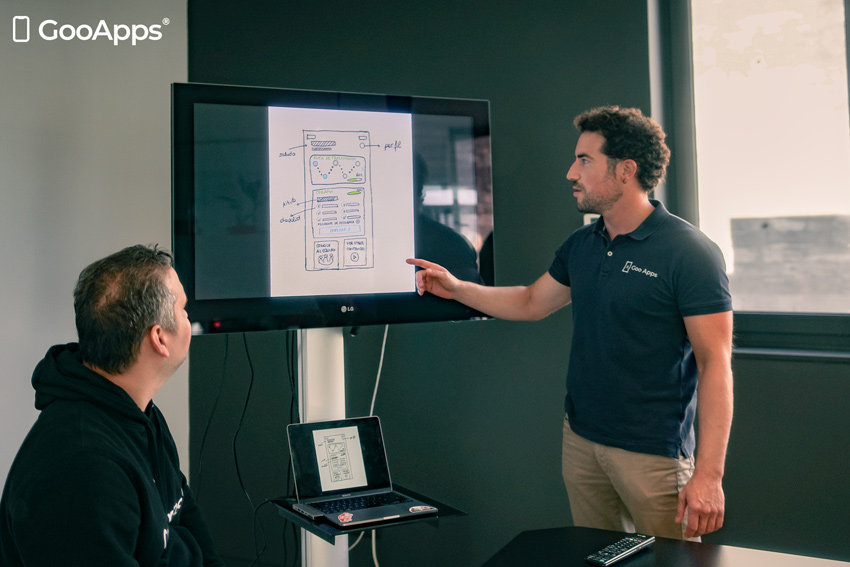
Effective development of an AI chatbot requires creating conversational sequences that are engaging and productive. The design process must incorporate user-related questions and suitable response types.
An artificial intelligence chatbot needs a conversational flow that is easy to use, understands context, and accepts different types of user input.
Designing efficient dialogues for the chatbot requires applying the following guidelines:
The training phase is one of the most important in building an AI chatbot. This is where the system learns to correctly interpret what users say and provide useful answers. The more data it receives, the more accurate its responses will be and the greater its ability to adapt.
Training is carried out using real conversations or existing datasets, enabling the chatbot to recognize language patterns and better understand the intention behind each message.
To achieve strong performance, it is advisable to:
In this way, the chatbot will be prepared to interact naturally in a wide variety of contexts.
Once trained, the next step is to connect the chatbot with the company’s internal systems.
Integration is usually carried out through APIs, which allow the chatbot to access information stored in customer databases (CRMs), booking systems, product catalogs, medical records, or payment platforms. This enables the chatbot to handle processes from beginning to end.
For example, in e-commerce, the chatbot can check the status of an order or initiate a return. In a clinic, it can schedule appointments directly in the doctor’s calendar. And in the financial sector, it can verify balances or block a card immediately.
It is important for the integration to be secure and scalable so that information is managed in compliance with regulations such as GDPR in Europe and so the system can grow with new features without losing stability.

Before launching an AI chatbot to the public, it is essential to test it in different scenarios. Testing makes it possible to detect errors, verify whether it correctly understands user intentions, and measure response speed.
Ideally, both types of tests should be combined:
In this phase, common issues are identified, such as inaccurate responses, difficulty understanding certain expressions, or interruptions in the conversation flow. With this information, the chatbot’s responses must be adjusted to make it more accurate.
The goal is to ensure that, when deployed in production, the chatbot provides a smooth, fast, and useful experience from the very first moment.
Once the tests have been validated and the model trained, it is time to launch the AI chatbot to the market. However, the work does not end with publication.
It is essential to establish a system of continuous monitoring that allows the analysis of metrics such as the number of interactions, the percentage of successfully resolved queries, or the points where users abandon the conversation. This data provides insight into how the chatbot is performing in practice.
With that information, the next step is ongoing optimization. The chatbot must be updated with new frequently asked questions, improve its responses based on received feedback, and expand its functionalities as the needs of the business and users evolve.
In this way, the chatbot becomes a living solution in continuous improvement, capable of adapting to the company’s growth and user expectations.
The world of AI chatbots is advancing at great speed, and every year new innovations emerge that make them more powerful and versatile. These are some of the most relevant.
Thanks to more advanced natural language processing models, chatbots are beginning to detect the user’s emotional state. In this way, they can adjust the tone of their response if they perceive frustration, urgency, or satisfaction, offering a more empathetic experience.
New AI chatbots do not limit themselves to remembering what the user has said in the current conversation. They incorporate long-term memory, which allows them to learn from previous interactions and provide much more personalized responses in future queries.
Current chatbots combine text, voice, and even image, allowing users to interact with them in more natural ways. A user can send a photo and receive a contextualized response or maintain a fluid voice conversation.
AI chatbots are increasingly integrating with virtual assistants such as Alexa or Google Assistant, as well as with wearables and IoT devices. This opens the door to applications in healthcare, sports, or wellness, where a chatbot can accompany the user in real time and from any device.
Today there are no-code platforms that make it possible to create an AI chatbot without needing programming knowledge. These applications give any company the ability to design a virtual assistant through graphical interfaces, dragging and dropping conversation blocks, or connecting preconfigured APIs.
Among their main advantages are fast development and lower cost. A company can have a functional chatbot in a matter of days, with a much smaller investment than a fully custom development. This makes no-code an appealing option for pilot projects, small businesses, or proof of concept initiatives.
However, these platforms also have important limitations. Customization is usually limited, making it difficult to create experiences that are truly adapted to the needs of the company. In addition, the lack of scalability can become a problem as the number of users grows or when it becomes necessary to integrate the chatbot with systems such as a CRM or any other third-party application.
Finally, dependency on an external provider means that control over security, technological evolution, and even data ownership remains in the hands of a third party.
Although no-code platforms offer a quick starting point, companies seeking a differential AI chatbot need a custom development.
To achieve this, a specialized team can design a chatbot that adapts to the specific context of the business. This includes everything from its communication style with users to its integration with internal systems such as ERPs, CRMs, or proprietary mobile applications. In addition, it can incorporate advanced features such as voice recognition, sentiment analysis, or long-term context memory, which are impossible to achieve with no-code applications.
Another critical aspect is security and regulatory compliance. In Europe, GDPR establishes strict obligations regarding the processing of personal data. In sectors such as healthcare or banking, a chatbot must be designed under the highest protection standards to ensure user trust.
Furthermore, experts not only develop the initial product, they also prepare it for growth and scalability. This means that the chatbot will be able to evolve alongside the company, incorporating new functionalities and supporting a higher volume of interactions without losing response quality.
At GooApps®, we are experts in artificial intelligence applied to healthcare, sports, and wellness. Our multidisciplinary team combines more than 15 years of experience in the design, development, and integration of technologies with a deep understanding of European regulations, including GDPR and the required medical certifications.
Whether it is an AI chatbot for companies, a health application with an intelligent assistant, or a digital solution that leverages the potential of artificial intelligence, at GooApps® we accompany you throughout the entire process.
If you are considering taking the next step and creating an AI chatbot tailored to your company, this is the right moment to do so with a partner that understands both the technology and the specific needs of your sector. At GooApps®, we are ready to help you transform your idea into a real and scalable solution.


Complete the form and GooApps® will help you find the best solution for your organization. We will contact you very soon!


 +34 675 549 894
 Schedule an online meeting